Edit lesson
Pre-course › Mandatory safety › Reserve packing - double opening Preview draft Publish this lesson- ImageEdit
 No alt text yet
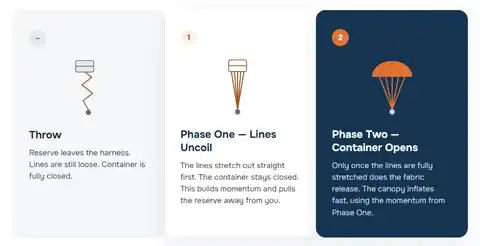
907 x 464 px - TextAs part of our gear check, we will offer you a choice: keep your reserve packed according to manufacturer specifications or repack it for fa...Edit
- TextPart of EN certification for our reserves is a Shock Test. This simple test involves dropping the reserve from a helicopter with its maximum...Edit
- TextLike all strength tests, the certification must consider worst-case scenarios. In paragliding, there are two scenarios where we can theoreti...Edit
- TextThere are several issues with this approach. First, as pilots, we prefer lightweight reserves, but lighter means less strong. Manufacturers ...Edit
- TextAs pilots, we want to get the reserve out of the harness and as far away from us as possible, with the fastest possible opening. This is cru...Edit
- TextWe'll discuss the specific differences during the course. For now, here are some comparison videos showing different packing methods.Edit
- H3Two phase opening vs Standard Opening.Edit
- VideoYouTube JCR4hxdrb64 from 35sEdit
- ImageClose
 Alt: Reserve deployment showing slow opening with leading edge folded, causing tangling in lines
1920 x 1080 px -
- TextHere’s the full videoEdit
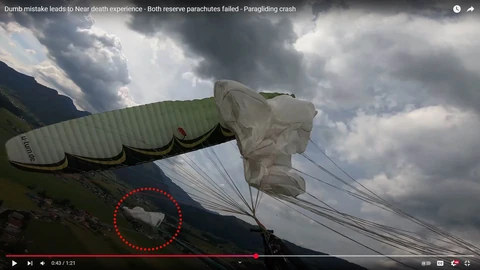
- TextIn the picture, you can see that the reserve is not opening quickly. Looking closely, you can see that the leading edge (the fabric closest ...Edit
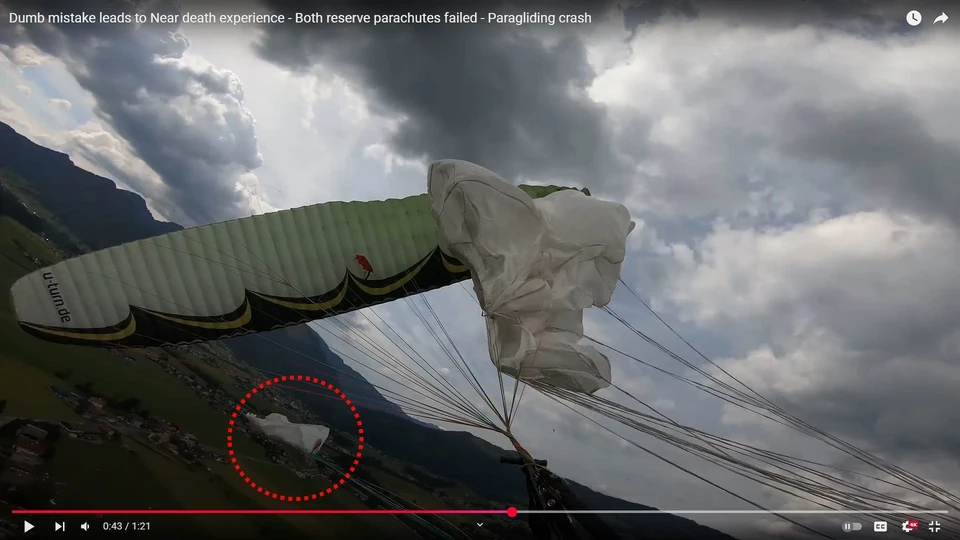
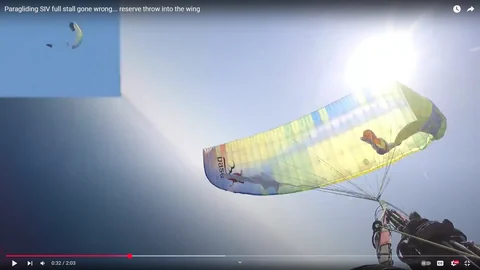
- TextHere’s another example, where a slow opening reserve, has been caught by the wing.Edit
- ImageEdit
 Alt: Reserve caught by wing during entanglement scenario showing deployment failure with slow op
1920 x 1080 px - VideoYouTube PyRWfZ3eZ6E from 29sEdit
- TextHere’s a video of Two Phase Opening - Click HereEdit
- VideoYouTube pYJbtmiHOn8 from 70sEdit
- ImageEdit
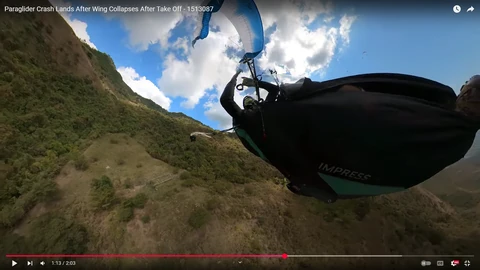 Alt: Double opening technique showing reserve flying away from harness with lines opening first
1920 x 1080 px - TextThe reserve flies away from the harness, the lines open first, this is the first step of opening, only once the lines are fully stretched, t...Edit
- ImageEdit
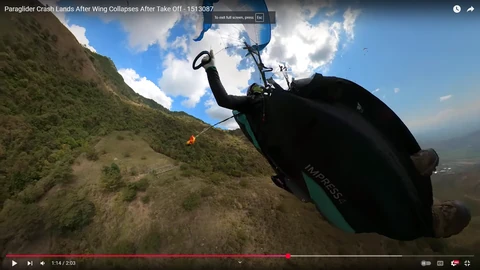 Alt: Double opening sequence showing lines fully stretched then fabric opening with momentum
1920 x 1080 px - TextThis is what I mean by two-phase opening: the lines open first, followed by the fabric.Edit
- TextWhen the lines open first, they create momentum for the reserve and help it deploy. As the lines are opening, gravity adds to your initial t...Edit
- TextThe Beamer 3 Reserves are factory packed for two-phase opening, these are bigger and stronger reserves, this is why they can pack them to op...Edit
- PDFBeamer 3 manual en PDF fileEdit
- H2Different types of packingEdit
- TextTo compare, you can have a look at Apco Mayday reserves packing manual.Edit
- PDFmanual mayday PDF fileEdit
- ImageEdit
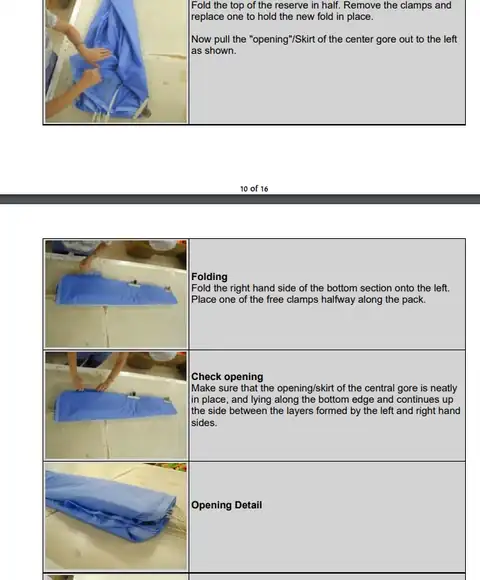 Alt: Reserve packing showing aerodynamic fold that slows opening compared to optimal packing
677 x 818 px - TextWhen you fold the reserve on itself and fold the leading edge like this, it will slow down the opening a lot. Like you can see in the first ...Edit
- Calloutgreen You want the reserve to be as loose as possible, with multiple openings near the air intake, to help it open fast.Edit
- TextHere’s another example of folding on itself, one side of the reserve is aerodynamic, meaning that the air will freely fly around it and do n...Edit
- PDFManual-S-120 -E PDF fileEdit
- ImageEdit
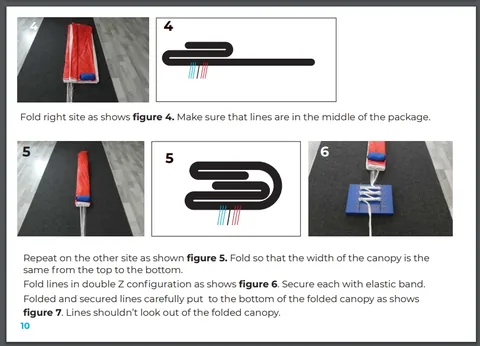 Alt: S-type packing with aerodynamic fold versus optimal packing with air intake on both sides
811 x 584 px - TextWhere an S like this will have air intake on both sides.Edit
- PDFmanuel sqr light2-FR PDF fileEdit
- ImageEdit
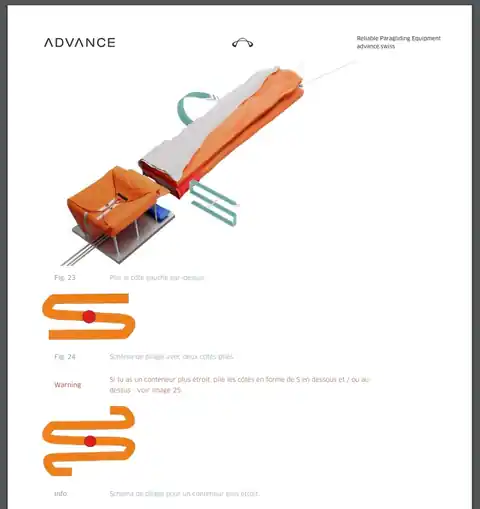 Alt: Simple S-type folding method for reserve packing with air intake on both sides
820 x 869 px - TextHere’s a simple S type of folding, this is quite a good way to do it, except for that the lines and fabric will be opening at the same time,...Edit
- VideoYouTube jTLRfHJBqZIEdit
- H2For me I always pack my own reserves as follows.Edit
- VideoYouTube BzrCVIaafh8Edit
- H2SummaryEdit
- TextIn theory, repacking your reserve for fast opening carries a small risk of breakage during free fall. To minimize these extreme scenarios, r...Edit
- TextFull line breakage is extremely rare, as long as you fly recent wings and maintain them properly, this should not be a concern.Edit
+ Add block at the endMoving a block never changes its text. Blocks are shown as the snapshot carries them.
Media
Works like the WordPress media library
Drop pictures here
or choose from your computer. Pictures: JPEG, PNG, WebP, GIF, HEIC, SVG. Documents: PDF.
new-photo.jpg 3.2 MB
Making web sizes, 70%
Picture details
1920 x 1080 px, JPEG
Web sizes are made automatically: 480, 960 and 1440 px, each as WebP and AVIF, plus a 960 px JPEG fallback.
Made for this picture
| Width | Format | Size |
|---|---|---|
| 480 px | WEBP | 22.5 KB |
| 960 px | WEBP | 62.3 KB |
| 1440 px | WEBP | 109.4 KB |
| 480 px | AVIF | 21.6 KB |
| 960 px | AVIF | 56.3 KB |
| 1440 px | AVIF | 105.3 KB |
| 960 px | JPEG (fallback) | 99.1 KB |
At 960 px, WebP is 37% smaller than the JPEG. Students get the smallest file that fits their screen.
This file
Replace keeps the file in every block that uses it. Delete asks first.