As part of our gear check, we will offer you a choice: keep your reserve packed according to manufacturer specifications or repack it for faster opening.
Part of EN certification for our reserves is a Shock Test. This simple test involves dropping the reserve from a helicopter with its maximum weight and letting it accelerate to 40 m/s descent speed before deployment.
Like all strength tests, the certification must consider worst-case scenarios. In paragliding, there are two scenarios where we can theoretically reach 40 m/s descent speeds: dual carabiner breakage or a full cascade of line breaks. Both scenarios result in free fall. Considering the time it takes for a pilot to react, locate, reach, and throw the reserve, estimates show we would reach just under 40 m/s before reserve deployment.
There are several issues with this approach. First, as pilots, we prefer lightweight reserves, but lighter means less strong. Manufacturers often pack these light reserves for slower opening to help them pass the shock test. Second, in real flying conditions, we spend most of our time close to the ground. If we need to throw our reserve, it's usually near terrain, which means we want the fastest possible opening. Third, the most common emergency scenario is auto-rotation, a SAT-like configuration where the wing flies forward while the pilot moves backward. With a slow-opening reserve, the wing often catches the reserve before it fully deploys, resulting in entanglement and deployment failure.
As pilots, we want to get the reserve out of the harness and as far away from us as possible, with the fastest possible opening. This is crucial when we're close to terrain or in auto-rotation, scenarios that are more likely than the extreme cases where we enter free fall.
We'll discuss the specific differences during the course. For now, here are some comparison videos showing different packing methods.
Two phase opening vs Standard Opening.
Here’s the
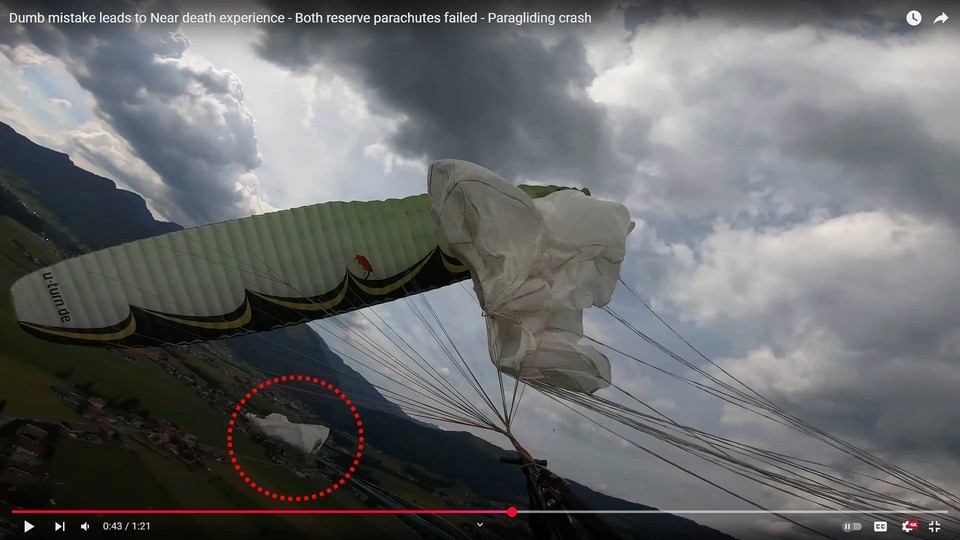
In the picture, you can see that the reserve is not opening quickly. Looking closely, you can see that the leading edge (the fabric closest to the lines) has been folded on itself. This makes it somewhat aerodynamic, causing air to flow around it instead of getting between the fabric layers to help it open. The slow opening keeps the reserve folded long enough to become tangled in the lines.
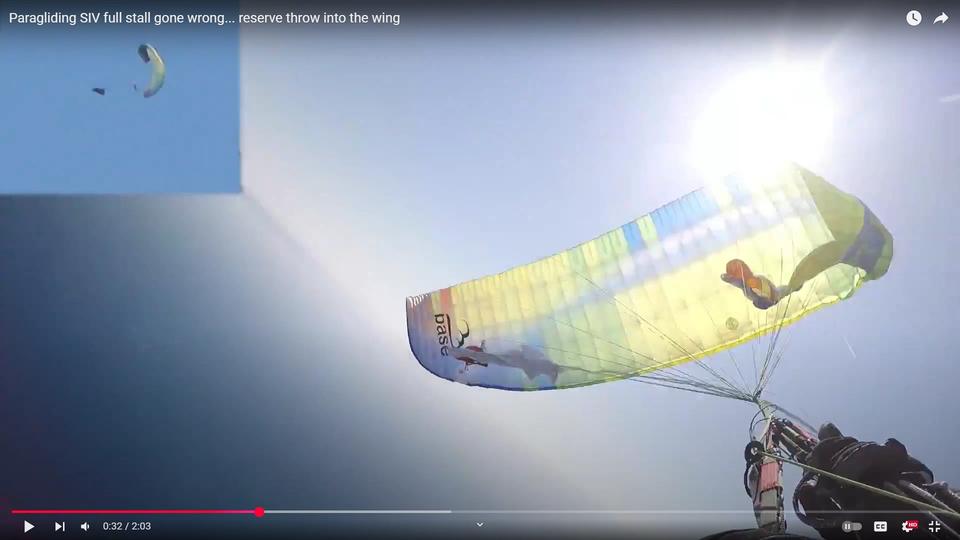
Here’s another example, where a slow opening reserve, has been caught by the wing.
Here’s a video of Two Phase Opening -
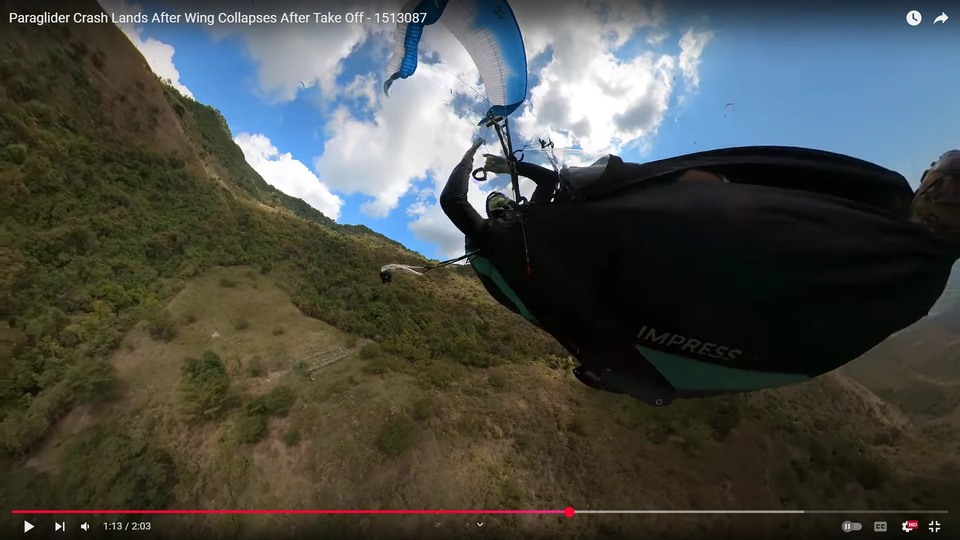
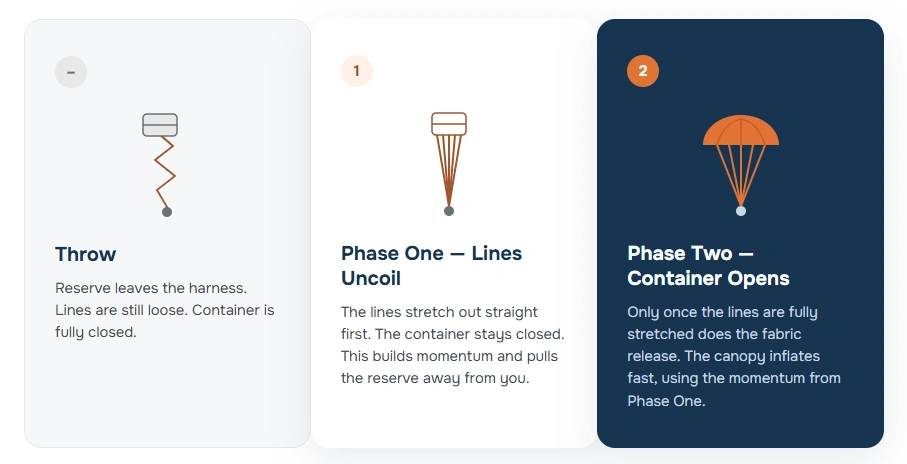
The reserve flies away from the harness, the lines open first, this is the first step of opening, only once the lines are fully stretched, the fabric of the reserve starts to open.
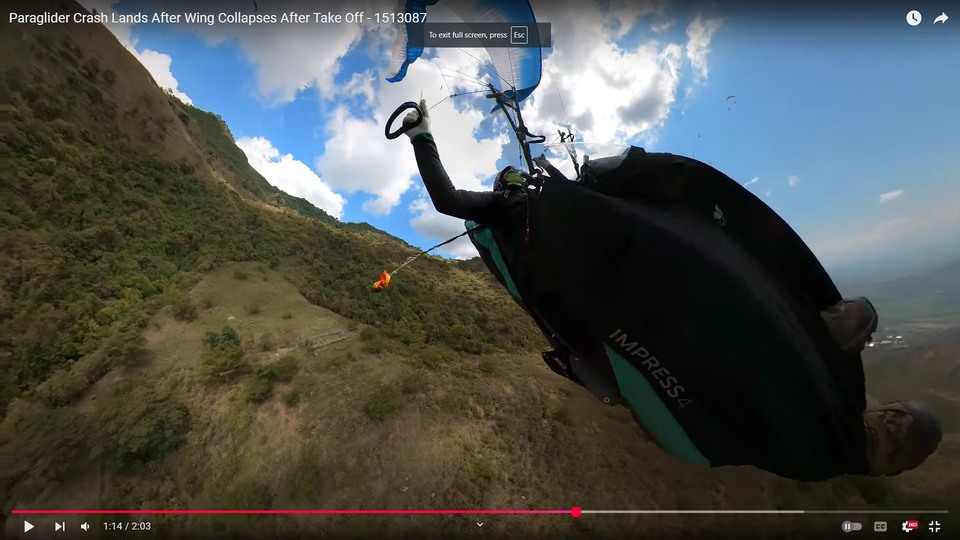
This is what I mean by two-phase opening: the lines open first, followed by the fabric.
When the lines open first, they create momentum for the reserve and help it deploy. As the lines are opening, gravity adds to your initial throw force. Once the lines are fully stretched, they pull back on the reserve, causing it to open faster.
The are factory packed for two-phase opening, these are bigger and stronger reserves, this is why they can pack them to open fast. Here’s the Packing Manual for Beamer 3
Beamer 3 manual enPDF, 4.2 MBOpen
Different types of packing
To compare, you can have a look at Apco Mayday reserves packing manual.
manual maydayPDF, 377 KBOpen
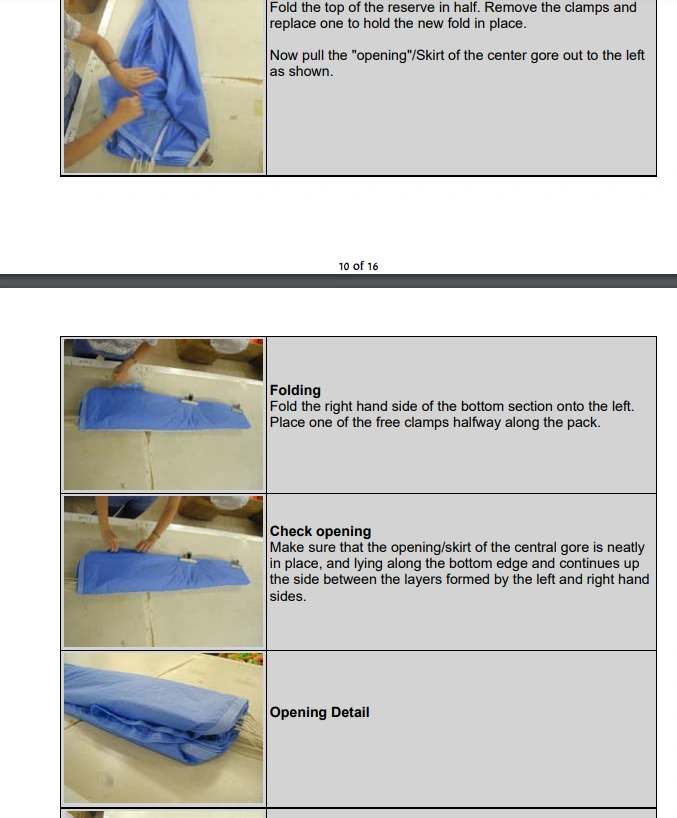
When you fold the reserve on itself and fold the leading edge like this, it will slow down the opening a lot. Like you can see in the first two videos higher up.
You want the reserve to be as loose as possible, with multiple openings near the air intake, to help it open fast.
Here’s another example of folding on itself, one side of the reserve is aerodynamic, meaning that the air will freely fly around it and do nothing to help opening it.
Manual-S-120 -EPDF, 853 KBOpen
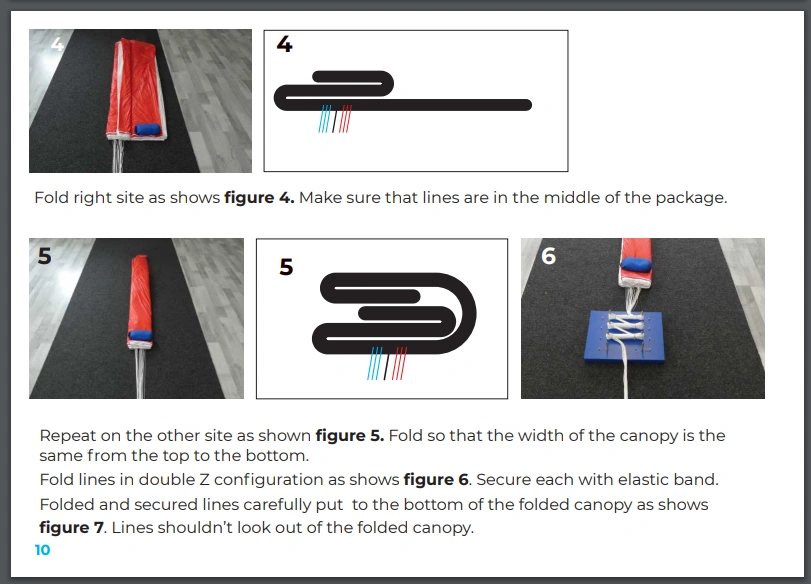
Where an S like this will have air intake on both sides.
manuel sqr light2-FRPDF, 1.3 MBOpen
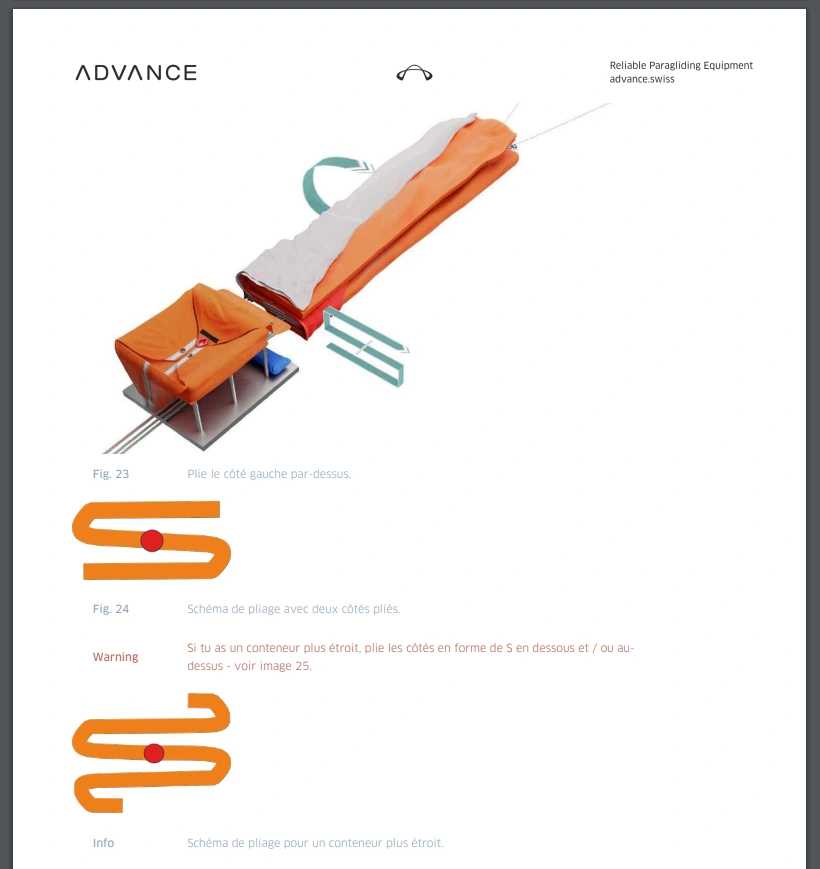
Here’s a simple S type of folding, this is quite a good way to do it, except for that the lines and fabric will be opening at the same time, there is a simple trick to upgrade this to two-phase opening.
For me I always pack my own reserves as follows.
Summary
In theory, repacking your reserve for fast opening carries a small risk of breakage during free fall. To minimize these extreme scenarios, regularly replace your harness carabiners. I recommend changing aluminum carabiners annually, while steel ones can last 2-3 years before replacement.
Full line breakage is extremely rare, as long as you fly recent wings and maintain them properly, this should not be a concern.